
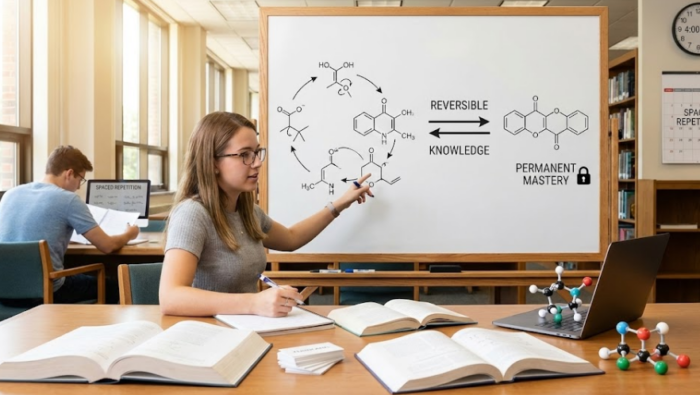
Chemistry does not only deal with memorising reactions, equations and definitions. Retaining information over time has been one of the greatest problems that students encounter in the A level. In such a way as a reversible reaction, knowledge is capable of reversion or decay unless properly treated. Students spend hours revising and forget important concepts days after. Learning to memorize information and take measures to ensure that the knowledge of chemistry becomes permanent is essential to the achievement of success in the long run.

Understanding Memory in Chemistry Learning
The chemistry memory can be considered a multi-step process. To begin with, students put information into memory through reading, listening, and practice. This is then succeeded by consolidation- of strengthening neural pathways due to repetition as well as active recollection. Lastly, retrieval enables the student to use the knowledge in exams or in real life situations.
Even the material that has been well learnt may be forgotten easily without reinforcement. This is the reason why a lot of students fail to recall mechanisms, conditions of reactions or periodic tendencies weeks after revising. Enrolling in A Level Chemistry Tuition can help students establish strategies that reinforce knowledge at every stage—encoding, consolidation, and retrieval.
Active Learning- Beyond Passive Memorization
The least effective way of remembering chemistry is passive memorization, that is, reading notes or highlighting textbooks. Rather, the techniques of active learning have a significant enhancement on the long-term retention.
- Practice Questions: Repetition of past paper questions is a sure way of applying concepts and not reading.
- Mind Mapping: Students should be able to draw connections between topics in diagrams i.e. thermodynamics and kinetics by connecting related ideas.
- Teaching Others: Being able to explain concepts to other individuals or even family members helps with clarification and identifying areas of ignorance.
Students attending A Level Chemistry Tuition often notice that these methods are systematically integrated into lessons. Making it easier to internalize complex content like organic reaction mechanisms or equilibrium calculations.

Spaced Repetition- The Key to Long-Term Retention
The method of spaced repetition is scientifically proven to avoid forgetting. The concept is very straightforward: the review takes place at gradually growing intervals. As an illustration a student could work on a topic on day one, repeat it three days after, and another seven days after and lastly in 2 weeks.The repetition of the lessons enhances the memory and reduces the chances of knowledge degradation.
Incorporating spaced repetition within A Level Chemistry Tuition sessions ensures that students consistently revisit difficult topics such as redox reactions and gradually commit them to long-term memory.
Retrieval Practice- Testing Your Knowledge
It will not be sufficient to re-read some notes. Retrieval practice The active recall of information without reference to the source is known as retrieval practice and makes the brain recreate knowledge pathways.
- Reaction condition or reaction mechanism flashcards.
- Periodic trends Self-quizzing.
- Memorization of equations.
All these methods enhance the speed and accuracy of retrieval. Regular guidance in A Level Chemistry Tuition helps students implement these practices effectively, turning temporary understanding into permanent mastery.
Linking Concepts for Better Retention
Memory is weak with mere memorization, but knowledge of the relationships between topics enhances memory. As an example, the student capable of relating bond energies with reaction enthalpies, or atomic structure with periodic trends, can recreate the information more easily during exams.
- A combination of physical with organic and inorganic chemistry.
- Knowing the reason behind every reaction, and not only how.
- Making parallels between theoretical concepts and laboratory research.
Students can learn in this connected manner and they have flexible knowledge just as chemical reasoning. Organized tutition is usually more focused on these connections so that students do not just forfeit facts, but concepts.
Practice Under Exam Conditions
It is when one is able to apply the knowledge under pressure that it becomes permanent. Problem solving in time limits, past paper practice and simulation exams assist the students to apply concepts effectively and quickly in a time constraint. It becomes particularly essential in multi-step organic mechanisms or the calculation of titrations.
By taking A Level Chemistry Tuition, learners get the opportunities to be exposed to exam-like situations many times again to strengthen the memory by doing instead of memorizing.
The Role of Feedback
It is as though learning without feedback was running a reaction with no catalyst and is slow and inefficient. Constructive feedback makes sure that the students are aware of the misconceptions at an early stage and rectify them, before they impact and become permanent.
- Individualized corrections on practice questions.
- Advice on how to make written explanations better.
- Understanding of conceptual misunderstandings.
It will be significant to give feedback following each session to make the students secure the right pathways in their memory and avoid error consolidation.
Environmental/Lifestyle Factors.
Memory retention also depends on lifestyle. Cognitive performance should be enhanced by ensuring that students have adequate sleep and that they take regular breaks between study sessions..
Statistically Speaking- The Top 3 Topics That Determine the Grade Boundary Each Year
In studying the aspect of A-Level Chemistry, there are always some topics that greatly influence the grade boundaries when preparing to take exams. The knowledge of these may enable students to be strategic in concentrating and better in results.
1. Organic Chemistry- Reactions and Synthesis
The most difficult part is often organic chemistry for A-Level students. The familiarity with reaction mechanisms, changes of functional groups and multi-step syntheses is often assessed. Errors in organic chemistry are heavily penalty-depreciating as many of the questions have multifaceted marks on learning mechanisms at a deeper level.
Students who invest time in A Level Chemistry Tuition learn systematic approaches to tackle organic questions, reducing errors and boosting confidence. Mechanism mapping, retrosynthetic analysis, and pattern recognition are advantages to the students.
2. Physical Chemistry- Calculations and Problem Solving
Physical chemistry deals with the calculation of thermodynamics, kinetics and equilibria; and gas laws. Questions that involve multi-step reasoning and accuracy in formula usage are very difficult for students. Minor errors in calculations may lead to huge points deductions.
Specific practice and active assistance during tuition lessons assist students in getting used to the regular patterns of calculations. This will make sure that the students will become accurate and speedy, which is essential in maximizing marks in physical chemistry.
3. Inorganic Chemistry- Periodicity and Reactions of Elements
Another field, which has much impact on grade boundaries, is inorganic chemistry, especially the periodic trends and chemistry of transition metals. Conceptual knowledge and the capacity to make connections between properties and electronic structure is tested by questions.
Through structured learning in A Level Chemistry Tuition, students practice connecting theory to observable trends, ensuring that they can answer application-based questions effectively. Teaching innovation on memorization techniques coupled with clarity of concepts favors memorization and performance in examinations.

Strategic Study- Maximizing Impact
The high-impact topics are prioritized and make efficient use of students in the study. In conjunction with such techniques as spaced repetition, retrieval practice, and active learning, strategic focus will make sure that students train the concepts that will most likely have an impact on the results of grading.
In addition, students who were well laid in terms of O Level Tuition in Chemistry tend to advance more, since they have a basis of information that will act as a scaffold to work through the more complicated subjects.